How Does Turnitin Work? Turnitin Explained in Plain English
Independent guide. Not affiliated with Turnitin, LLC. Read the Turnitin disclaimer.
Turnitin is software that checks written work in two ways: it finds text that matches other sources (the similarity report) and estimates how much was written by AI (the AI writing report). Here's how each part works, in plain English.
Step 1: Your file is uploaded
Most people submit through Canvas, Moodle, Blackboard, Brightspace or Turnitin's own site. Turnitin extracts the text from your DOCX, PDF or other supported file type.
Step 2: The similarity check
Turnitin breaks your text into small chunks and compares them against three kinds of source:
- Internet: current and archived web pages.
- Publications: journals, books and periodicals.
- Submitted works: papers previously submitted to Turnitin's repository.
Matches are grouped by source and added up into a similarity score. A match isn't automatically plagiarism: properly quoted and cited text matches too.
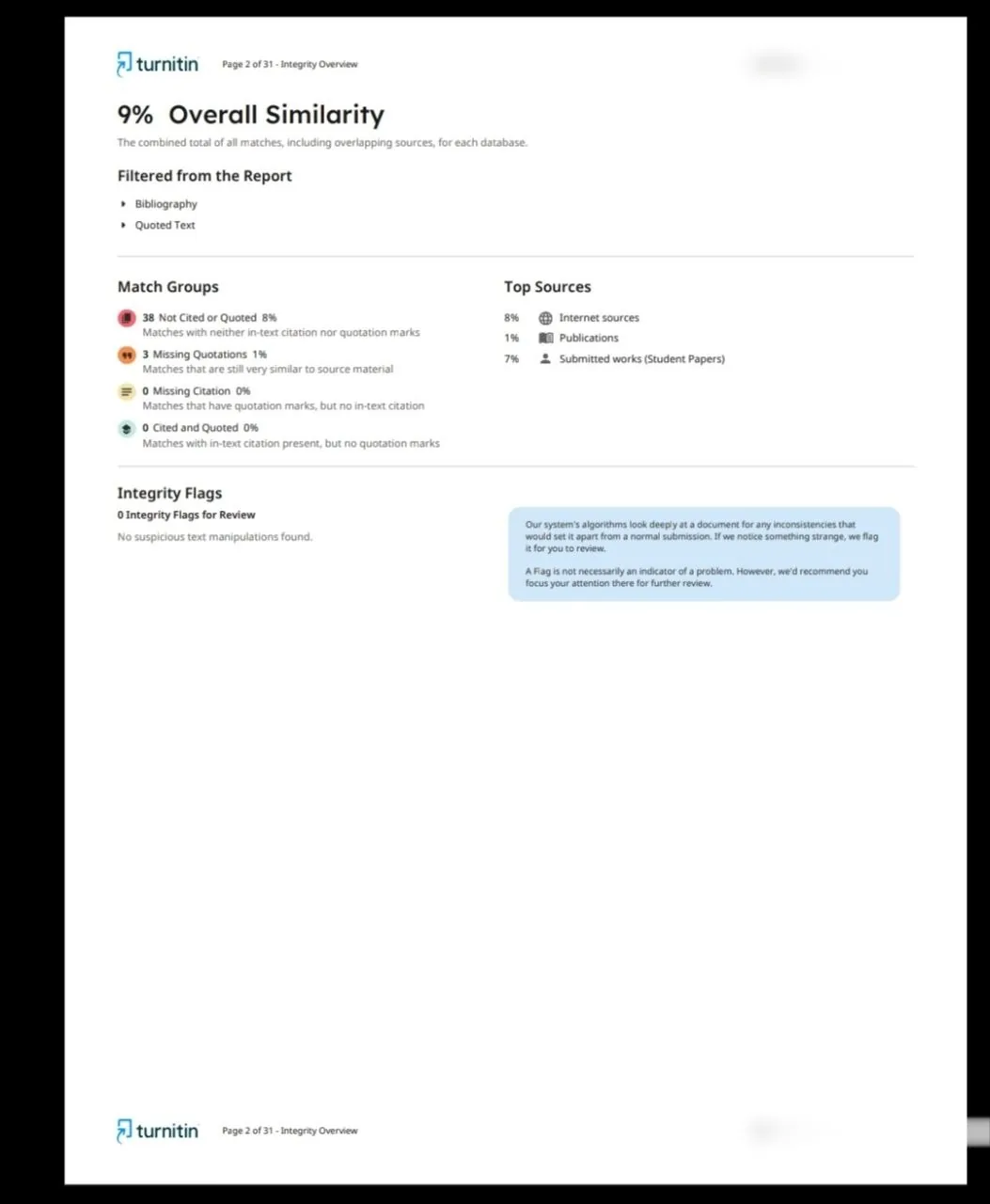
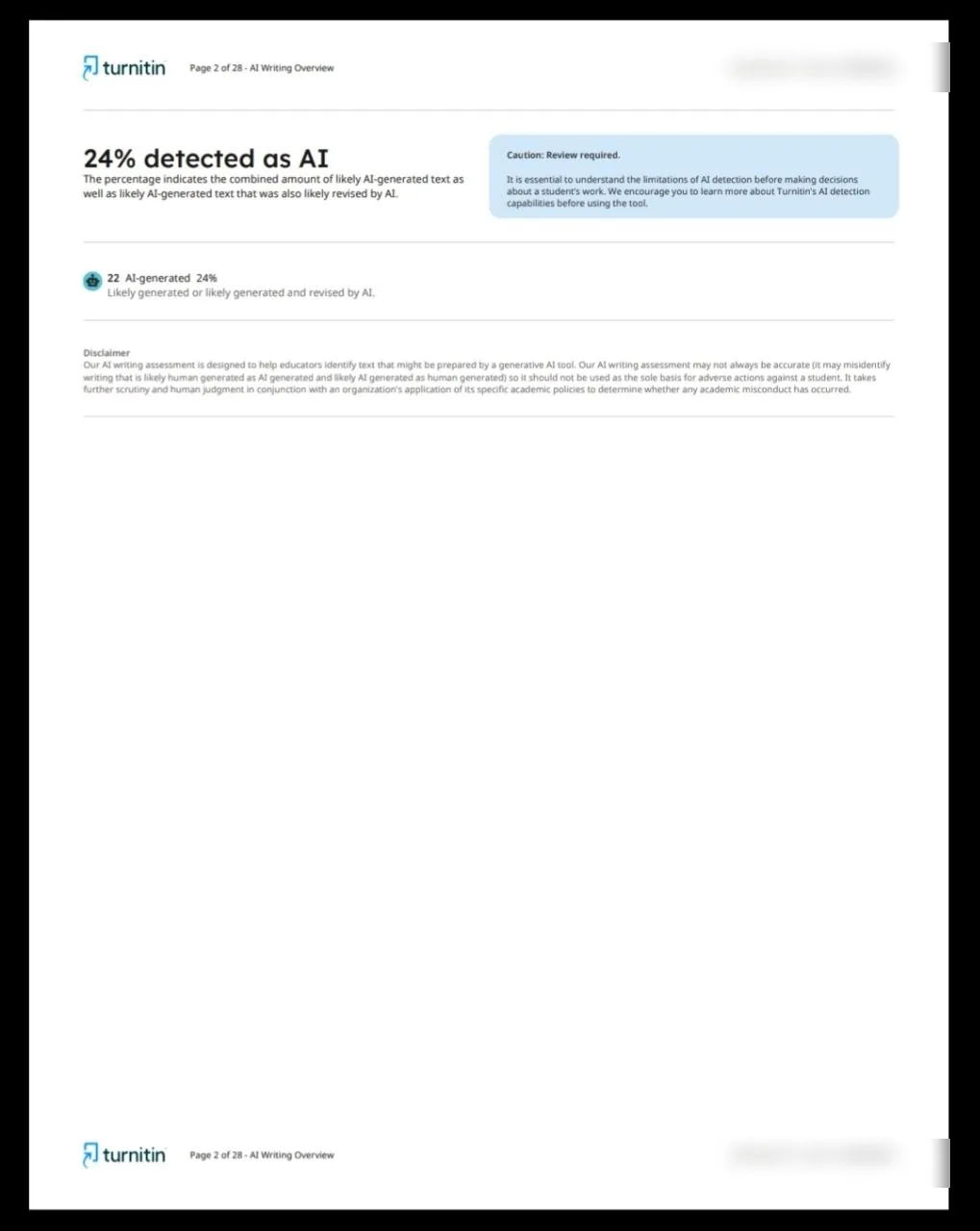
Want the full PDFs? Open a sample Turnitin similarity report and a sample Turnitin AI report. Yours arrive in the same format, usually within 30 minutes.
Step 3: The AI writing check
Turnitin's AI model splits the text into overlapping segments and scores how likely each one is to be AI-generated, based on patterns in word choice and structure. Since 2025 it also flags AI text that was paraphrased or put through a humanizer (bypasser detection, English only). It works for long-form English, Spanish, Japanese, Arabic, German, Dutch and Turkish (full list).
Step 4: Someone reads the reports
Turnitin doesn't decide whether you cheated. An instructor, editor or panel reads the reports and decides. Turnitin itself says AI scores shouldn't be the only basis for action.
What Turnitin is used for
| Who | Use |
|---|---|
| Schools and universities | Originality and AI checks on assignments, feedback and grading |
| Publishers (iThenticate) | Screening manuscripts before publication |
| Researchers | Checking theses and articles |
Can you see your own Turnitin scores?
Often you see the similarity score but not the AI score. You can get both privately: $3.50 per document, ready usually within 30 minutes. If the AI score is high, our editors humanize it for $5.99 per 200 words.
Frequently asked questions
How does Turnitin check for plagiarism?
It compares your document with billions of web pages, published works and previously submitted papers, then highlights matching text and gives an overall similarity percentage.
Does Turnitin detect AI?
Yes, where the institution has AI writing detection enabled. It estimates the percentage of text likely AI-generated or AI-modified, in supported languages.
What is Turnitin used for?
Mainly checking originality of submitted work at schools, universities and publishers, giving feedback and, increasingly, flagging likely AI writing.
See your Turnitin AI and similarity scores first.
- Turnitin similarity report (PDF)
- Turnitin AI writing report (PDF)
- Not stored in any shared repository
- Ready usually within 30 minutes
2 free checks with every 10 you buy.
Get my Turnitin reportsFlagged as AI? Our editors rewrite it by hand.
- Human editors, not another AI tool
- Aims for a 0% Turnitin AI score, proofreading included
- Fresh Turnitin AI report of the edited file as proof
- Delivered within 12 to 24 hours
Questions? WhatsApp us on +254706770780.